Tarkov Cheat Prices: What You'll Pay and Why
Tarkov Cheat Prices: What You’ll Pay and Why

Tarkov cheat prices are tiered: entry-level ESP/radar software runs $5–$10/month, full-featured suites with aimbot and multi-ESP filters cost around $15–$30/month, and DMA hardware setups require an $80–$300 one-time hardware purchase plus a $15–$50/month firmware subscription. For most buyers, a monthly software subscription is the right starting point. If you’re planning to play long-term and want maximum detection resistance, DMA is worth the upfront cost.
Here’s how those tiers map to real purchase decisions:
- Casual or new buyer: Start with an entry-level subscription like Phoenix Lite — ESP and radar features at an affordable monthly rate.
- Regular player who wants full features: A mid-tier subscription like Phoenix covers aimbot, full ESP, custom filters, and kernel-level injection.
- Long-term or high-stakes player: DMA hardware plus firmware subscription, paired with an HWID spoofer for ban recovery.
Key Takeaways
Tarkov cheat prices range from $5–$10/month for entry-level ESP, $15–$30/month for full-featured suites, and $80–$300 upfront for DMA hardware plus $15–$50/month for firmware. The right choice depends on your budget, how long you plan to play, and your preferred balance of convenience versus detection risk.
| Point | Details |
|---|---|
| Entry-tier pricing | ESP/radar subscriptions start at $5–$10/month; best for new or casual buyers. |
| Full-suite pricing | Aimbot plus multi-ESP suites run $15–$30/month with kernel-level injection. |
| DMA hardware cost | One-time $80–$300 for the card, plus $15–$50/month firmware; cost-effective long-term. |
| Top safety step | Always pair any cheat with an HWID spoofer and a burner account to limit ban exposure. |
| Valkyrieee options | Phoenix Lite covers the entry tier; Phoenix covers the full suite; HWID Spoofer adds ban recovery. |
Table of Contents
- How are Tarkov cheat prices structured across billing models?
- Which features drive Escape from Tarkov cheat costs up?
- Why do Tarkov cheats cost more than cheats for other games?
- What risks come with buying Tarkov cheats, and how do you reduce them?
- How do you evaluate a seller and compare prices fairly?
- How does Valkyrieee’s pricing map to the market?
- Legal and ethical considerations that affect pricing and availability
- Primary sources and further reading
- What most price guides get wrong about Tarkov cheats
- Valkyrieee covers every price tier with products built to last
- Sources
How are Tarkov cheat prices structured across billing models?
According to market data, Escape from Tarkov cheat costs vary significantly depending on how a seller bills and what architecture the cheat uses. Understanding the billing model is the first step to comparing offers fairly.
| Billing Model | Typical Price Range | Notes |
|---|---|---|
| Daily pass | $2–$5/day | High per-unit cost; useful for testing |
| Monthly subscription | $5–$30/month (starter tiers $5–$10/month, full suites $15–$30/month) | Most common; scales with features |
| Lifetime license | $80–$150 one-time | Riskier if provider shuts down |
| DMA hardware (card) | $80–$300 one-time | Requires compatible motherboard slot |
| DMA firmware subscription | $15–$50/month | Paid separately on top of hardware |
| HWID spoofer (add-on) | $5–$20/month | Often sold as a separate module |
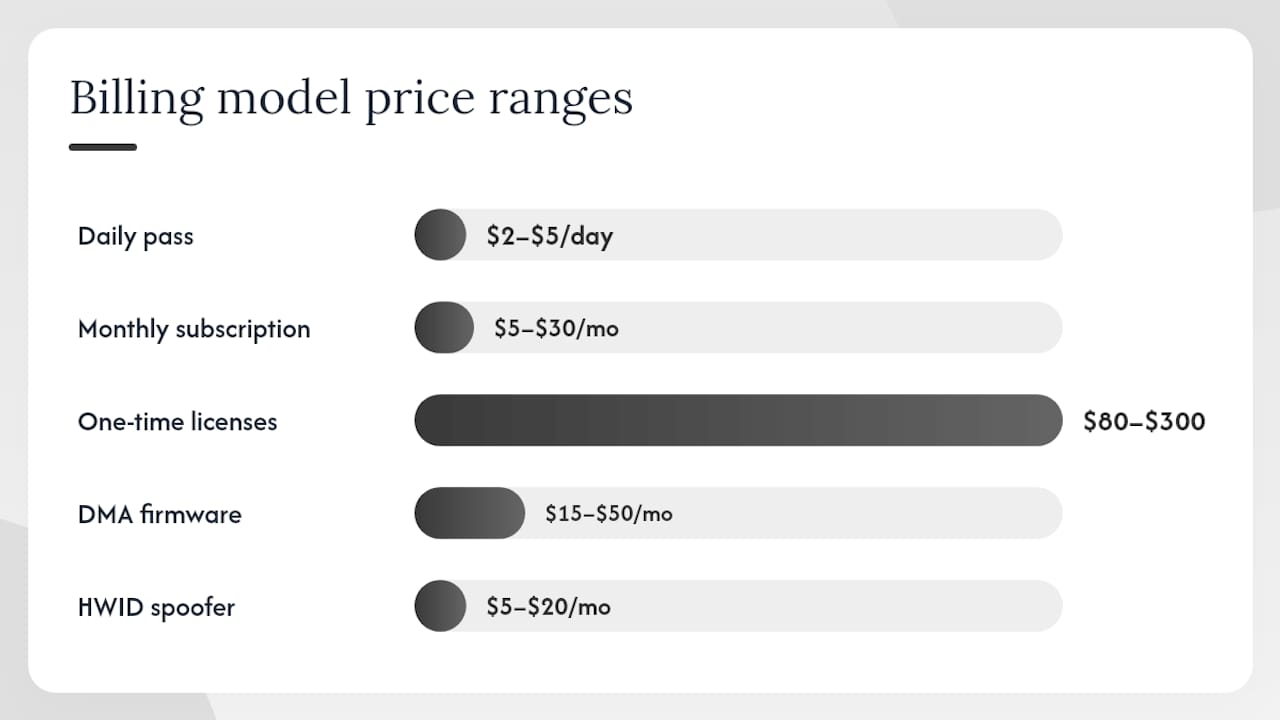
Some vendors list monthly prices starting in the single-digit dollar range for basic access and higher rates for full-featured suites, with lifetime options and DMA firmware billed separately at a mid-range monthly cost.
First-year cost scenarios:
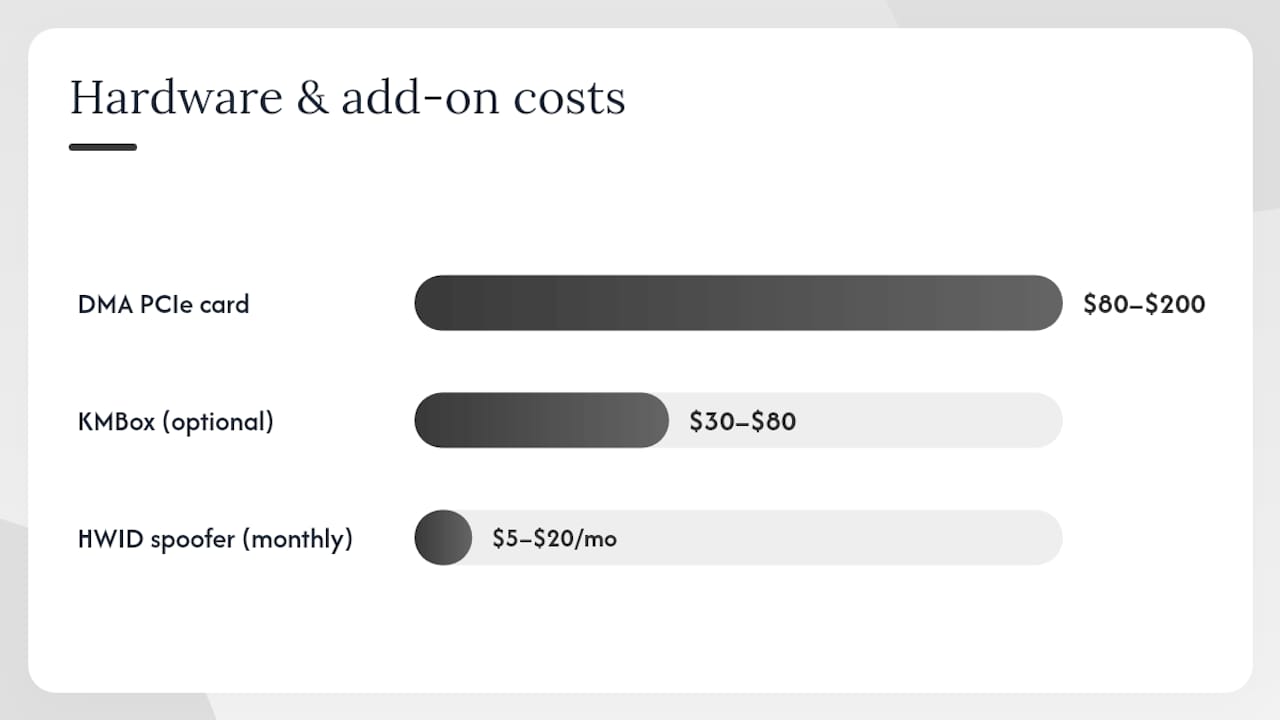
A casual buyer who picks a $10/month software subscription and adds a $10/month HWID spoofer pays roughly $240 for the year. A long-term player who buys a $150 DMA card, an optional KMBox peripheral ($30–$80), and pays $30/month in firmware fees lands around $510–$590 in year one — but year two drops to just the firmware cost. Community forum threads confirm this pattern, with some users reporting hardware purchases around $300 and monthly firmware around $60, plus lifetime DMA options cited near $550.
For buyers focused on cheap Tarkov cheats that stay safe, the monthly software route with a spoofer add-on offers the best cost-to-risk ratio in year one.
Which features drive Escape from Tarkov cheat costs up?
Not every price difference reflects quality. Some features genuinely require more engineering and maintenance. Others are bundled to justify a higher price tag. Here’s what actually moves the needle:
- Kernel-level driver injection: Bypasses user-mode detection by operating at a lower system level. Harder to develop, harder to maintain after game patches, and priced accordingly. This is the main reason full-suite cheats cost more than basic radar tools.
- DMA (Direct Memory Access) hardware: Reads game memory from a separate PCIe card, making software-based anti-cheat nearly blind to it. The hardware cost is real — cards run $80–$200, with an optional KMBox at $30–$80 for mouse/keyboard emulation.
- Aimbot sophistication: Basic aimbot is cheap to implement. Bone-prioritization, recoil compensation, and humanized movement curves require ongoing tuning after every major Tarkov update. That maintenance cost shows up in the subscription price.
- Multi-ESP filters: Loot ESP with custom item filters, player ESP with distance/health overlays, and container highlighting each add development overhead. A cheat with all three costs more than one with a single player overlay.
- HWID spoofer: Sold as a separate module by most providers. It masks your hardware fingerprint so a hardware ban doesn’t lock you out permanently. Expect $5–$20/month on top of your cheat subscription.
- Account services: Fresh EFT accounts with full access are sometimes bundled or sold separately. These carry their own cost because they require manual creation and verification.
- Advanced exploits like debug camera access or game-bending features sit at the top of the price range — they’re niche, high-maintenance, and priced to reflect that.
Pro Tip: For new buyers, an ESP-only or ESP-plus-basic-aimbot subscription gives you the highest value per dollar. Full aimbot suites cost more and carry higher detection risk — start light, add features once you understand the risk profile.
The architecture choice (DMA vs. kernel vs. user-mode) matters more than the feature list for long-term cost. User-mode cheats are cheapest but most detectable. Kernel-level sits in the middle. DMA is the most expensive upfront but the hardest for BattlEye to catch.
Why do Tarkov cheats cost more than cheats for other games?
Three structural factors push EFT cheat prices above the market average for most other titles.
Smaller user base, higher per-user cost. Tarkov has a dedicated but niche player count compared to titles like Warzone or CS2. Providers spread development and maintenance costs across fewer subscribers, which means each subscription carries more overhead.
BattlEye’s update cadence. Tarkov runs BattlEye, one of the more active kernel-level anti-cheat systems. BattlEye pushes detection signature updates frequently, and every update can break a cheat’s injection method. Providers who want to stay undetected need a developer actively monitoring and patching — that ongoing labor cost is baked into the monthly price. A cheat that goes unpatched for two weeks after a BattlEye update gets users banned. Providers who take that seriously charge more.
Wipe cycles and game updates. Tarkov’s periodic wipes and content patches often break cheat functionality at the memory-offset level. Every major patch requires a full re-map of game memory addresses. That’s a recurring engineering cost that doesn’t exist for more static games.
Community forum data backs this up: DMA hardware discussions show wide price variation and active aftermarket resale, which reflects both the high upfront cost and the uncertainty around provider longevity. When a provider stops maintaining their firmware, users are left with expensive hardware and no working cheat — so the secondary market for DMA cards is real.
What risks come with buying Tarkov cheats, and how do you reduce them?
The risks split into four categories. Each one has a concrete mitigation step.
- Account ban: BattlEye detects the cheat and bans your EFT account. Mitigation: use a burner account, not your main. Keep your main account clean.
- HWID ban: Battlestate Games issues a hardware ban that blocks your machine from connecting. Mitigation: run an HWID spoofer before launching any cheat. A spoofer masks your hardware fingerprint so a ban doesn’t stick to your machine.
- Malware: Low-cost or free cheats from unverified sources frequently contain keyloggers, RATs, or crypto miners. Mitigation: only buy from providers with verifiable Trustpilot reviews, a public changelog, and a refund policy. Never run an unsigned executable from a Discord DM.
- Scams and refund issues: Fake lifetime keys, unverifiable HWID spoofers, and sellers who disappear after payment are common. Mitigation: verify that the seller has a published refund or money-back policy before paying. Check third-party review platforms for recent negative patterns.
Before you run any cheat software: pair it with a hardware spoofer and a fresh burner account. These two steps together reduce your exposure to permanent bans more than any other single precaution. Skipping either one means a single detection event can cost you your hardware access and your main account simultaneously.
Common scam patterns to watch for: sellers offering “permanent undetected” lifetime keys at suspiciously low prices (under $20 one-time), providers who claim their spoofer works without showing a changelog or update history, and escrow-style payment requests that bypass normal checkout flows. If a deal looks too clean to be true at that price, it usually is.
For a deeper breakdown of ban mitigation strategies, Valkyrieee’s guide on cheating safely covers the full account-protection workflow.
How do you evaluate a seller and compare prices fairly?
Price alone tells you almost nothing. A $10/month cheat that gets detected in week two costs more than a $25/month subscription that stays clean for six months. Use this checklist before paying anyone.
Trust signals to look for:
| Signal | What to Check |
|---|---|
| Transparent pricing | Prices listed publicly, no “DM for price” |
| Public changelog | Update history showing active maintenance |
| Trial or demo access | Even a short trial shows confidence |
| Refund or money-back policy | Written policy, not just a verbal promise |
| Third-party reviews | Trustpilot, forum threads, verified purchase reviews |
| Undetected proof | Status page or recent detection-free history |
Red flags that should stop you:
- No refund policy or “all sales final” language
- No changelog or update history visible
- “Undetected since launch” claims with no proof or status page
- Forced one-time key transfer with no account system
- Price significantly below the market floor (under $5/month for a full suite)
- No community presence or verifiable reviews
Questions to ask any seller before paying:
- How often do you push updates after a BattlEye signature change?
- What happens to my subscription if the cheat gets detected?
- Is the HWID spoofer included or a separate purchase?
- What is your refund policy if the cheat stops working?
Valkyrieee publishes transparent pricing, maintains a changelog, and backs its products with a 4.7 Trustpilot rating across more than 20,000 subscriptions sold — the kind of verifiable trust signals that separate a reliable provider from a short-lived operation.
How does Valkyrieee’s pricing map to the market?
Valkyrieee’s product line covers all three major price bands, with each product matched to a specific buyer profile.
| Product | Features | Market Position |
|---|---|---|
| Phoenix Lite | ESP, radar-style features, entry-level | Entry tier ($5–$10/month range) |
| Phoenix | Full aimbot, multi-ESP, custom filters, kernel-level injection | Mid-to-full tier ($15–$30/month range) |
| HWID Spoofer | Hardware fingerprint masking, ban recovery support | Add-on module, priced separately |
Phoenix Lite is the right starting point if you want ESP and radar features without paying for aimbot you’re not ready to use. Phoenix covers the full feature set — aimbot with customizable settings, full ESP with item and player filters, and kernel-level injection that keeps the cheat below BattlEye’s standard detection threshold.
The HWID spoofer is a separate product by design. Bundling it forces every buyer to pay for it whether they need it or not. Buying it separately means you add it when you’re ready to run a burner-account workflow.
Valkyrieee uses custom kernel-level injection methods across its cheat products, which places them in the same detection-resistance tier as providers charging at the higher end of the market. The combination of over 20,000 subscriptions sold and a 4.7 Trustpilot rating gives you third-party confirmation that the products work as described — not just a vendor’s own claim.
Legal and ethical considerations that affect pricing and availability
Purchasing or using cheat software for Escape from Tarkov sits in a clear legal and ethical gray zone that affects both what you pay and how reliably you can access what you buy.
From a legal standpoint in the United States, using cheat software doesn’t typically constitute a criminal offense for the end user. However, it violates Battlestate Games’ Terms of Service, which means your account can be terminated without recourse or refund. Providers who operate in this space face more direct legal exposure under the Computer Fraud and Abuse Act (CFAA), which is one reason reputable providers invest in legal structuring and why fly-by-night operations disappear quickly. That legal pressure on providers is a real cost driver — it’s part of why established providers charge more than anonymous Discord sellers.
Ethically, cheating in a shared multiplayer environment affects other players’ experience. That’s a personal decision, and this article doesn’t argue either way. What it does note is that the ethical dimension affects the market: providers who operate openly and transparently tend to charge more because they’re building a sustainable business rather than a quick exit. Providers who price suspiciously low are often operating without that long-term calculus.
Availability is also affected by platform enforcement. Battlestate Games actively pursues DMCA takedowns and cease-and-desist actions against cheat providers. Providers who survive those actions are the ones with legal and technical infrastructure — and that infrastructure costs money that shows up in subscription prices.
Primary sources and further reading
| Source | Why It’s Relevant |
|---|---|
| Valkyrieee EFT Cheats product page | Official pricing, feature list, and trust signals for Valkyrieee products |
| Phoenix Lite product page | Entry-level product details and pricing |
| HWID Spoofer product page | Spoofer features and ban-recovery use cases |
| EFTHacks market summary | Independent market price ranges and feature comparisons |
| Elitepvpers DMA price thread | Community-reported DMA hardware and firmware costs |
| Valkyrieee cheap cheats article | Budget-tier options and safety tradeoff analysis |
What most price guides get wrong about Tarkov cheats
The standard advice on Tarkov cheat prices focuses almost entirely on the monthly subscription number. That’s the wrong metric to optimize for.
The real cost of a cheat subscription is the total cost across its useful life, divided by the number of sessions you get before a detection event. A $10/month cheat that gets detected in week three and costs you a $50 account replacement has an effective cost of $80 for three weeks of access. A $25/month cheat that stays clean for six months costs $150 for the same period — and you keep the account.
Most buyers underestimate how much account replacement costs factor into the total. Fresh EFT accounts aren’t free, and if you’re running on your main account without a spoofer, a single detection event can cost you years of progression. The HWID spoofer isn’t an optional add-on for careful buyers — it’s the minimum viable safety layer for anyone running cheat software regularly.
The other thing guides consistently miss: provider longevity matters more than the feature list. A provider with a public changelog, verifiable reviews, and a refund policy is more likely to still be operating in six months than one offering a suspiciously cheap lifetime key. You’re not just buying software — you’re buying ongoing maintenance from a team that has an incentive to keep the cheat working.
Valkyrieee covers every price tier with products built to last
If you’ve read this far, you know what separates a fair price from a risky one. Valkyrieee’s product line is built around exactly that calculus: transparent pricing, kernel-level injection that holds up against BattlEye updates, and a refund policy that backs the product’s claims.
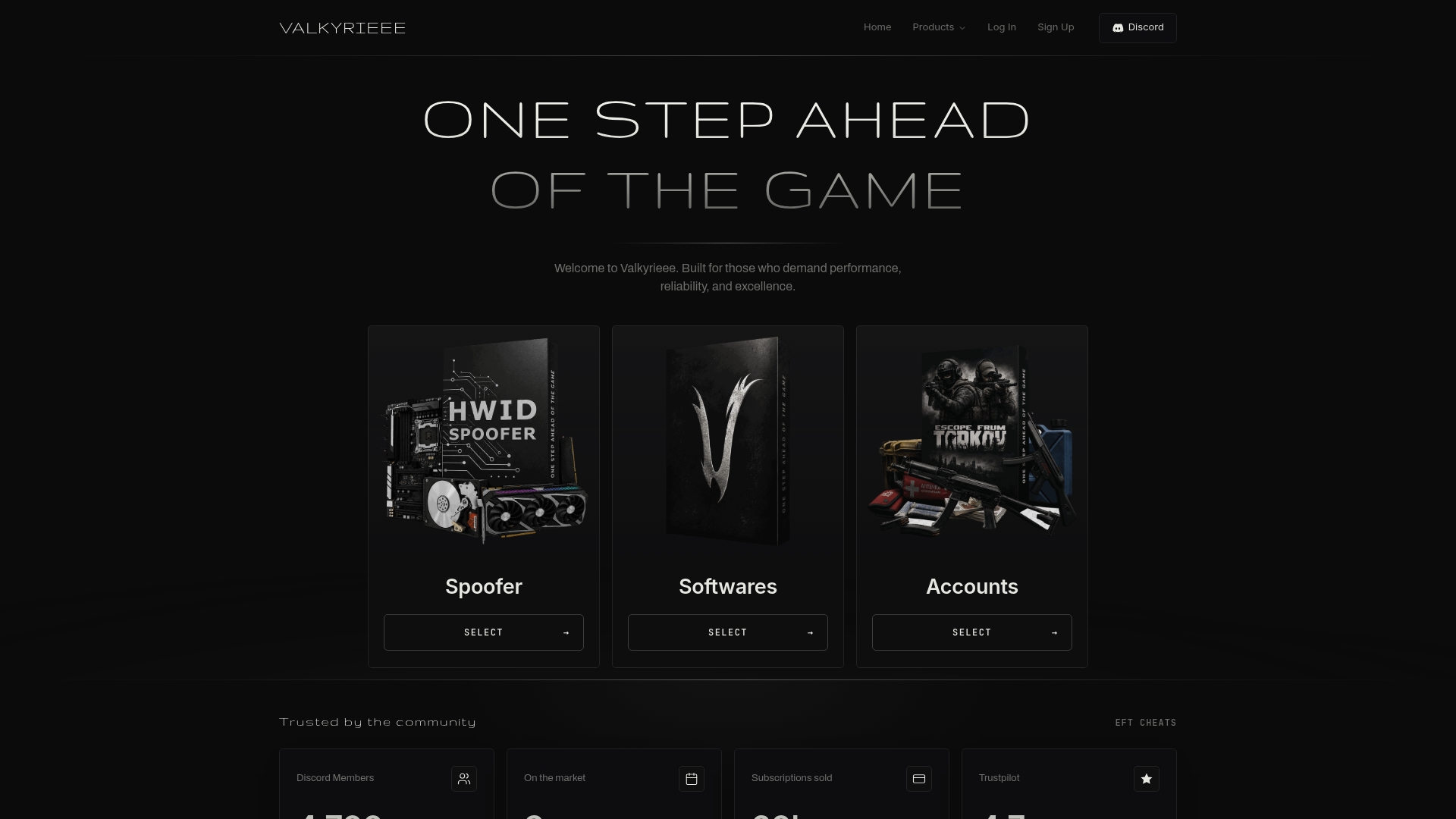
Phoenix Lite gives entry-tier buyers ESP and radar features at a $5–$10/month price without paying for a full aimbot suite they don’t need yet. Phoenix delivers the complete package — aimbot, full ESP with custom filters, and kernel-level injection — at a price that sits squarely in the mid-tier market range. The HWID Spoofer adds the hardware-ban protection layer that every serious buyer should be running. Over 20,000 subscriptions sold and a 4.7 Trustpilot rating aren’t marketing claims — they’re the kind of track record that tells you the products work and the team stays active after your purchase.
Check current pricing and pick your tier at Valkyrieee’s EFT cheats page, or go straight to Phoenix Lite if you’re starting at the entry level.
Sources
Recommended
- Why People Cheat in Escape From Tarkov (And How to Do It Safely)
- Cheap Escape From Tarkov Cheats That Are Still Safe (2026) - Valkyrieee
- Escape from Tarkov Cheats: The Real Way to Stay One Step Ahead Without Losing Your Account - Valkyrieee
- Escape From Tarkov Cheats – Undetected EFT Hacks & ESP | Valkyrieee
Article generated by BabyLoveGrowth
Ready to compare features side by side? Buy Tarkov cheats directly from Valkyrieee with instant delivery.
Our Software
Try our software yourself
Three versions, one goal: keep you one step ahead. Pick the one that fits your playstyle.
Phoenix Chams
Chams-focused and budget friendly, the easiest way to get an edge in every raid.
Phoenix Chams gives you player and item chams so you always see what matters through walls, without the price of the full suite. The simplest and cheapest way to try Valkyrieee and start winning more fights.
Phoenix Lite
Lighter version that gives you the essential features and focuses on safe, simple and stable gameplay.
Phoenix Lite includes only the most important features like chams, infinite stamina, recoil control and basic ESP. It is designed for safe and low-profile gameplay, so you can improve without anything too complex. If you want something easy, stable and clean, Lite is the better option.
Phoenix
Full version of our software, made for players who want every feature and complete control in every raid.
Phoenix includes every feature we offer: aimbot, full ESP, price filters and many more that help you control every raid from start to finish. It works for both legit and rage playstyles, so you can play safe or go all-in. The strongest and most complete option.