Game Cheating Laws: What Every Player Needs to Know
Game Cheating Laws: What Every Player Needs to Know

Cheating in video games is almost never a crime in the United States for ordinary players. The primary legal levers are the End User License Agreement (EULA), copyright law, the Digital Millennium Copyright Act (DMCA), and the Computer Fraud and Abuse Act (CFAA) — and in practice, enforcement lands on cheat creators and distributors far more often than on individual players. The most likely outcomes for you as a player are:
- Account suspension or permanent ban (the most common result by far)
- Loss of purchased in-game items and progress
- Civil claims against cheat software makers, not typically against end users
- Criminal exposure only in narrow cases involving malware, account theft, or fraud
This article covers every major legal tool publishers use, the statutes that can create real criminal risk, and what to do if you receive a ban or legal notice. Key entities referenced throughout: EULA, DMCA, CFAA, copyright law, Bungie, Epic Games, Take-Two Interactive, and the proposed Safer Gaming Act (H.R. 6265).
Table of Contents
- Why cheating is usually a civil matter, not a criminal one
- Federal and state statutes that can apply to cheating-related conduct
- What major lawsuits against cheat makers actually show
- Specific behaviors that can cross into criminal territory
- Key Takeaways
- The real reason publishers chase sellers, not players
- Primary sources and further reading
Why cheating is usually a civil matter, not a criminal one
The reason most cheating stays in civil territory comes down to how games are legally structured. When you install a game, you do not own it. You license it. That license is the EULA, and it is a private contract between you and the publisher. Breaking it is a breach of contract, not a crime. Publishers can terminate your license, ban your account, and pursue civil damages — but they cannot call the police simply because you used an aimbot.
Federal privacy and data laws like COPPA regulate how publishers handle your data, but none of them criminalize in-game behavior. The EULA is the governing document for what you can and cannot do inside the game. Publishers write those agreements broadly, and courts have generally upheld their right to enforce them through account-level penalties.
Copyright law and the DMCA are aimed at a different target: the people who build and sell cheat software. Publishers use copyright and EULA-based civil claims to target cheat creators and distributors, treating litigation as a market-disruption tool rather than a mechanism to criminally prosecute every player who downloaded a trainer. That distinction matters for how you read the risk.
Criminal prosecution of an ordinary player requires more than rule-breaking. Statutes like the CFAA demand specific elements: unauthorized access, fraud, or harm tied to malware. Simply using a client-side cheat in a multiplayer game does not automatically satisfy those elements. That is why the enforcement pipeline almost always ends at the account level for players, while cheat sellers face the courtroom.
“Criminal statutes require more than rule-breaking — they require statutory elements like unauthorized access, fraud, or malware-related harm. Ordinary gameplay cheating rarely meets that threshold.” — Digital Law Journal, on CFAA and EULA enforcement
Pro Tip: If you receive any legal notice related to in-game activity, screenshot it immediately with a timestamp visible, save the email headers, and do not delete your account or wipe your device before consulting a lawyer. Evidence you destroy after receiving notice can be treated as spoliation.
Federal and state statutes that can apply to cheating-related conduct
The statutes below are the ones most likely to come up in a serious enforcement context. Most players will never encounter them. Cheat creators, distributors, and anyone involved in account theft or fraud face a different picture.
| Statute | Plain-English Summary | Conduct It Targets |
|---|---|---|
| CFAA (18 U.S.C. § 1030) | Prohibits unauthorized access to protected computers | Account takeovers, bypassing authentication, accessing game servers without permission |
| DMCA § 1201 | Bans circumventing technological protection measures | Cracking DRM, bypassing anti-cheat kernel drivers |
| Federal wire fraud (18 U.S.C. § 1343) | Prohibits schemes to defraud using electronic communications | Selling fake in-game items, fraudulent account sales |
| Identity theft (18 U.S.C. § 1028) | Prohibits using another person’s identifying information | Stealing and reselling game accounts with real payment data attached |
| State computer crime laws | Vary by state; many mirror CFAA language | Unauthorized access, malware distribution, credential theft |
The CFAA is the statute most frequently cited in gaming-adjacent criminal cases. Its key phrase is “unauthorized access” — and courts have debated what that means in a gaming context for years. Using a cheat that sends modified packets to a game server you are authorized to connect to sits in a legal gray zone. Distributing malware that harvests other players’ login credentials is not gray at all.
Several states have their own computer crime statutes that can apply independently of federal law. California’s Comprehensive Computer Data Access and Fraud Act, for example, mirrors CFAA language but applies to state-level prosecutions. Texas, New York, and Florida have similar frameworks. If conduct crosses state lines — which online gaming almost always does — federal jurisdiction typically applies alongside any state charge.
The DMCA also has criminal provisions under Section 1204. Willful circumvention of technological protection measures for commercial advantage or private financial gain can result in fines and imprisonment. This is aimed squarely at cheat sellers operating at scale, not at a player who downloaded a free trainer.
Note: Laws like the CFAA and state computer crime statutes are complex, and their application to gaming scenarios is still evolving in courts. This article is general information, not legal advice. Consult a licensed attorney if you face any criminal allegation or formal legal threat.
The proposed Safer Gaming Act (H.R. 6265) would add a new layer by requiring providers to offer safeguards for minors on gaming networks. It does not criminalize cheating directly, but it signals that Congress is paying closer attention to online gaming conduct and publisher obligations.
What major lawsuits against cheat makers actually show
The most instructive enforcement actions in U.S. gaming history have targeted cheat software companies, not individual players. Historical litigation and publisher enforcement actions illustrate the industry’s reliance on civil suits, bans, and IP claims to manage cheating. Three cases stand out:
Bungie v. AimJunkies (2022–2023). Bungie sued the operators of AimJunkies.com for distributing cheat software for Destiny 2, alleging copyright infringement, DMCA violations, and tortious interference. The case produced significant pretrial rulings on what conduct constitutes DMCA circumvention in a gaming context and highlighted how publishers use multi-theory complaints to maximize pressure on defendants.
Epic Games v. multiple defendants. Epic has pursued dozens of cheat creators and distributors for Fortnite, winning default judgments and injunctions against sellers who failed to appear in court. The damages in these cases have reached into the hundreds of thousands of dollars in statutory copyright damages alone.
Take-Two Interactive v. RockstarCheater and similar defendants. Take-Two has aggressively pursued cheat tool operators for Grand Theft Auto Online, using DMCA and copyright claims to shut down cheat marketplaces and recover damages.
“Publishers aim to ‘chill the market’ for cheats rather than criminally pursue each end user — litigation is a supply-side strategy, not a demand-side one.” — Cheating in Online Games, Wikipedia
What these cases show for players is straightforward: publishers are spending legal resources on the sellers, not on you. The cheat marketplace itself is the target. That said, being a named distributor or reseller — even informally — puts you in a very different legal position than being a subscriber.
Court dockets for federal cases are publicly searchable on PACER. If you want to track active publisher litigation, PACER is the primary source.
Specific behaviors that can cross into criminal territory
Not all cheating carries the same legal weight. Here is a clear breakdown of what typically stays civil versus what can trigger criminal statutes:
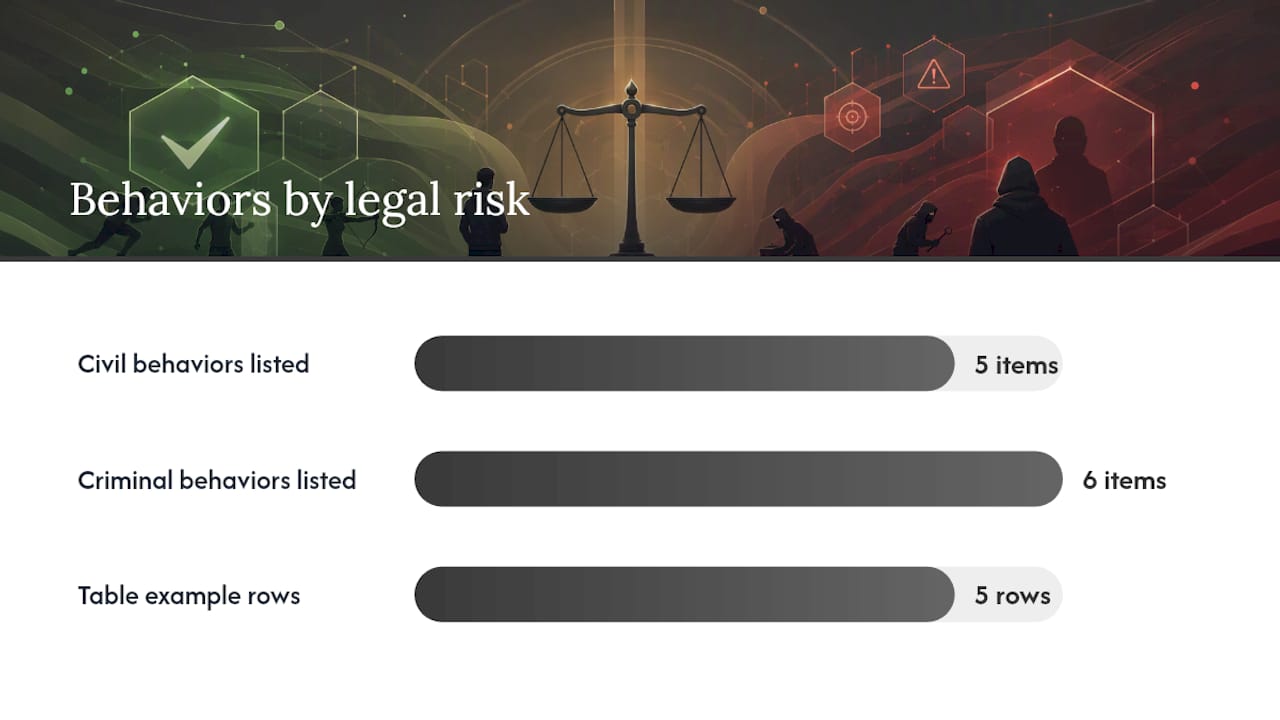
Behaviors that usually remain civil (EULA/account-level enforcement):
- Using an aimbot or ESP in a multiplayer game
- Running a single-player trainer or offline mod
- Exploiting in-game bugs or unpatched mechanics
- Using a client-side speed hack that does not access other players’ data
- Modifying game files on your own machine without distributing the modification
Behaviors that commonly produce criminal exposure:
- Distributing malware bundled with cheat software that harvests credentials (CFAA, federal computer fraud)
- Selling stolen accounts that contain real payment information (identity theft statutes, wire fraud)
- Using stolen credit card data to purchase in-game currency or accounts (18 U.S.C. § 1029, access device fraud)
- Circumventing DRM at scale for commercial gain (DMCA § 1204 criminal provisions)
- Unauthorized access to game servers beyond what your account credentials permit (CFAA § 1030)
- Operating a cheat subscription service that requires bypassing anti-cheat kernel drivers (DMCA + potential CFAA)
| Behavior | Legal Category | Likely Outcome |
|---|---|---|
| Using aimbot in multiplayer | Civil / EULA breach | Account ban |
| Selling cheat subscriptions | Civil + potential criminal | Lawsuit, injunction, damages |
| Distributing credential-harvesting malware | Criminal | Federal prosecution |
| Bypassing HWID ban with spoofer | Civil (aggravated EULA breach) | Permanent ban, escalated enforcement |
| Selling stolen accounts | Criminal | Federal charges |
Pro Tip: Hardware ID (HWID) spoofing to bypass a hardware ban is treated by publishers as an aggravated EULA breach. It does not automatically create criminal liability, but it signals willful circumvention and can escalate enforcement from a simple ban to a formal legal action. Read more about how kernel-level cheats interact with detection systems before using any bypass tool.
Key Takeaways
Cheating in video games in the U.S. is primarily a civil and contractual matter, with criminal liability reserved for conduct involving fraud, malware, or large-scale commercial distribution of cheat software.
| Point | Details |
|---|---|
| Civil, not criminal, by default | Most cheating is enforced through EULA bans and civil claims, not criminal prosecution. |
| Cheat creators are the primary targets | Publishers sue sellers and distributors to disrupt supply, not individual players who used the software. |
| Criminal lines are specific | CFAA, wire fraud, and DMCA criminal provisions apply when conduct involves unauthorized access, malware, or fraud. |
| Account loss is the real risk for players | Bans, HWID blocks, and lost purchases are the practical consequences most players face. |
| Get a lawyer for any criminal threat | If a notice references criminal statutes or a court filing, consult licensed counsel before responding. |
The real reason publishers chase sellers, not players
The conventional framing of game cheating laws focuses on whether cheating is “illegal.” That framing misses the more interesting question: why do publishers spend millions in legal fees on cheat sellers while largely ignoring the players who bought their products?
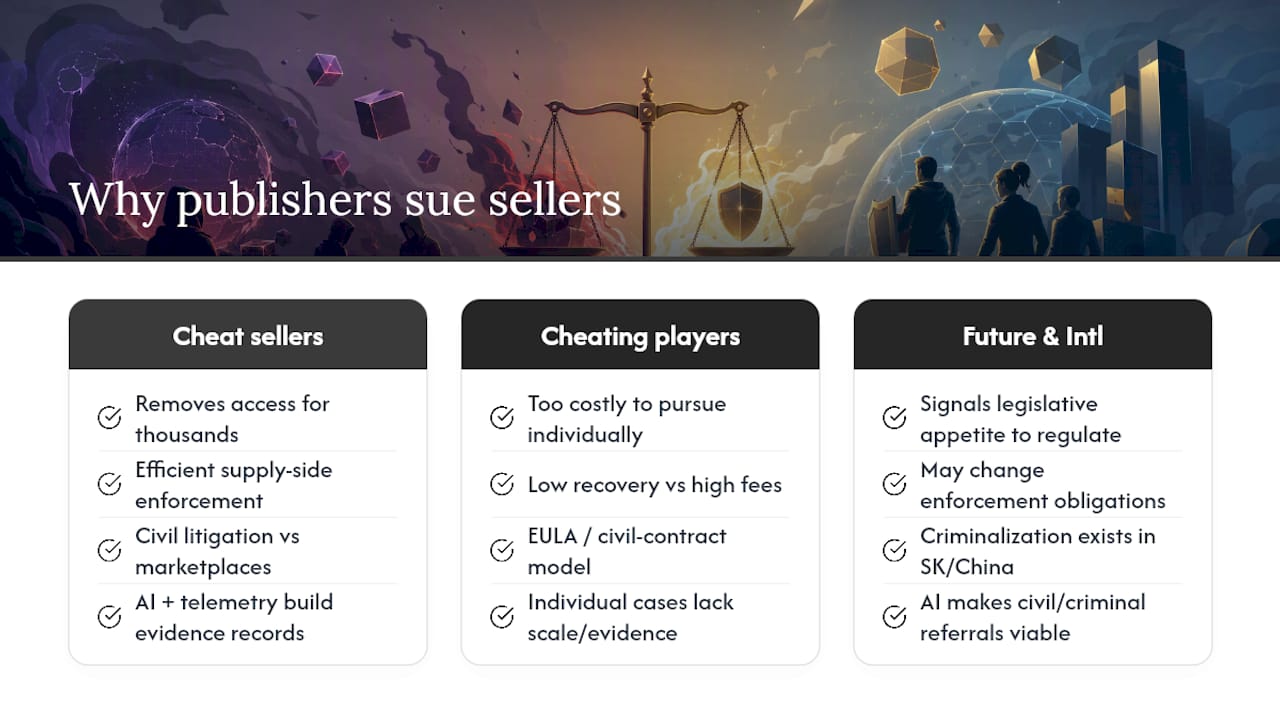
The answer is economics, not ethics. A single successful lawsuit against a cheat marketplace removes access for thousands of players at once. Pursuing those players individually would cost more in legal fees than any realistic recovery. Publishers are running a supply-side enforcement strategy, and it works. Academic research on cheating taxonomies confirms that fairness is a core security design goal in multiplayer systems, and publishers have learned that disrupting the supply chain protects that goal more efficiently than chasing demand.
The shift to AI-driven, server-side detection changes the calculus further. Generative AI and behavioral telemetry have reshaped how cheats are built and detected in 2026, making it harder for cheat tools to stay undetected and easier for publishers to build behavioral evidence records. That evidence is what makes civil cases viable and what could, in theory, support a criminal referral if the conduct is serious enough.
The Safer Gaming Act represents a potential inflection point. If passed, H.R. 6265 would require providers to build safeguards for minors into gaming networks. That does not criminalize cheating, but it signals a legislative appetite for regulating online gaming conduct more broadly. Publishers who have built their enforcement strategies around civil litigation may eventually face statutory obligations that change how they handle player data, detection, and enforcement disclosures.
Internationally, the contrast is stark. South Korea and China have criminalized the sale and use of cheat software directly. The U.S. has not gone that far, and the civil-contract model has served publishers well enough that there is no strong industry push for criminal legislation targeting players. That could change if esports integrity becomes a federal priority, but for now, the EULA remains the primary line of defense.
Primary sources and further reading
The statutes, cases, and resources below are the authoritative references for the legal claims in this article.
Key statutes:
- Cheats and anti-cheat technologies in the context of copyright: issues of qualification and liability | Digital Law Journal
- Game laws in the U.S. | LegalMovesLawFirm
- A guide to identifying cheating in online video games in 2026 | GamesIndustry.biz
- H.R.6265 — Safer Guarding of Adolescents from Malicious Interactions on Network Games Act (bill text) | Congress.gov
- Sony v Datel: IP Law vs Mods, Cheats And Hacks In Video Games | Mondaq
- Cheating in online games — Wikipedia
- Video game law overview | Justia
- Cheating behaviors in online gaming | ResearchGate
Authoritative sources used in this article:
| Source | Type | Best Used For |
|---|---|---|
| CFAA (18 U.S.C. § 1030) | Federal statute | Criminal exposure analysis |
| DMCA (17 U.S.C. § 1201) | Federal statute | Anti-circumvention and DRM bypass claims |
| Digital Law Journal | Peer-reviewed article | IP and EULA enforcement against cheat makers |
| Justia video game law | Legal reference | Publisher civil toolbox overview |
| Sony v. Datel (Mondaq) | Case commentary | Copyright limits on runtime-variable cheats |
| GamesIndustry.biz 2026 guide | Industry report | Detection methods and AI telemetry |
| H.R. 6265 (Congress.gov) | Bill text | Proposed legislative changes to provider obligations |
Recommended
- Kernel-Level Cheats Explained: Why They Stay Undetected (2026) - Valkyrieee
- Why People Cheat in Escape From Tarkov (And How to Do It Safely)
- Are Escape From Tarkov Cheats Safe? How to Cheat Without Getting Banned (2026) - Valkyrieee
- Escape from Tarkov Cheats: The Real Way to Stay One Step Ahead Without Losing Your Account - Valkyrieee
Article generated by BabyLoveGrowth
If you decide the risk profile works for you, choose a provider that takes safety seriously — see how Valkyrieee Escape from Tarkov cheats approach detection and account protection.
Our Software
Try our software yourself
Three versions, one goal: keep you one step ahead. Pick the one that fits your playstyle.
Phoenix Chams
Chams-focused and budget friendly, the easiest way to get an edge in every raid.
Phoenix Chams gives you player and item chams so you always see what matters through walls, without the price of the full suite. The simplest and cheapest way to try Valkyrieee and start winning more fights.
Phoenix Lite
Lighter version that gives you the essential features and focuses on safe, simple and stable gameplay.
Phoenix Lite includes only the most important features like chams, infinite stamina, recoil control and basic ESP. It is designed for safe and low-profile gameplay, so you can improve without anything too complex. If you want something easy, stable and clean, Lite is the better option.
Phoenix
Full version of our software, made for players who want every feature and complete control in every raid.
Phoenix includes every feature we offer: aimbot, full ESP, price filters and many more that help you control every raid from start to finish. It works for both legit and rage playstyles, so you can play safe or go all-in. The strongest and most complete option.